What Is Webbing Tape?
Webbing tape is a strong, narrow woven textile used for carrying, fastening, reinforcing, adjusting, decorating and securing products across many industries. It appears in bags, luggage, garments, furniture, outdoor equipment, packaging, industrial products and countless accessories.
For global buyers searching for a Webbing tape manufacturer in India, understanding material, weave and construction is the first step toward sourcing the correct product. Webbing should not be selected by width and colour alone. Fibre type, yarn specification, density, thickness, finish and intended load all influence performance.
How Webbing Is Manufactured
Webbing belongs to the narrow woven fabrics category. Warp yarns run along the length of the tape while weft yarns interlace across the width. Narrow-fabric looms control the weave structure and edges to create continuous tapes.
Changing yarn type, number of ends, weave pattern and density can alter strength, flexibility, thickness, texture and appearance. This is why two webbings made from the same fibre and width can perform very differently.
A useful narrow woven fabrics guide therefore starts with construction rather than treating all tapes as interchangeable.
Types of Webbing Tape by Material
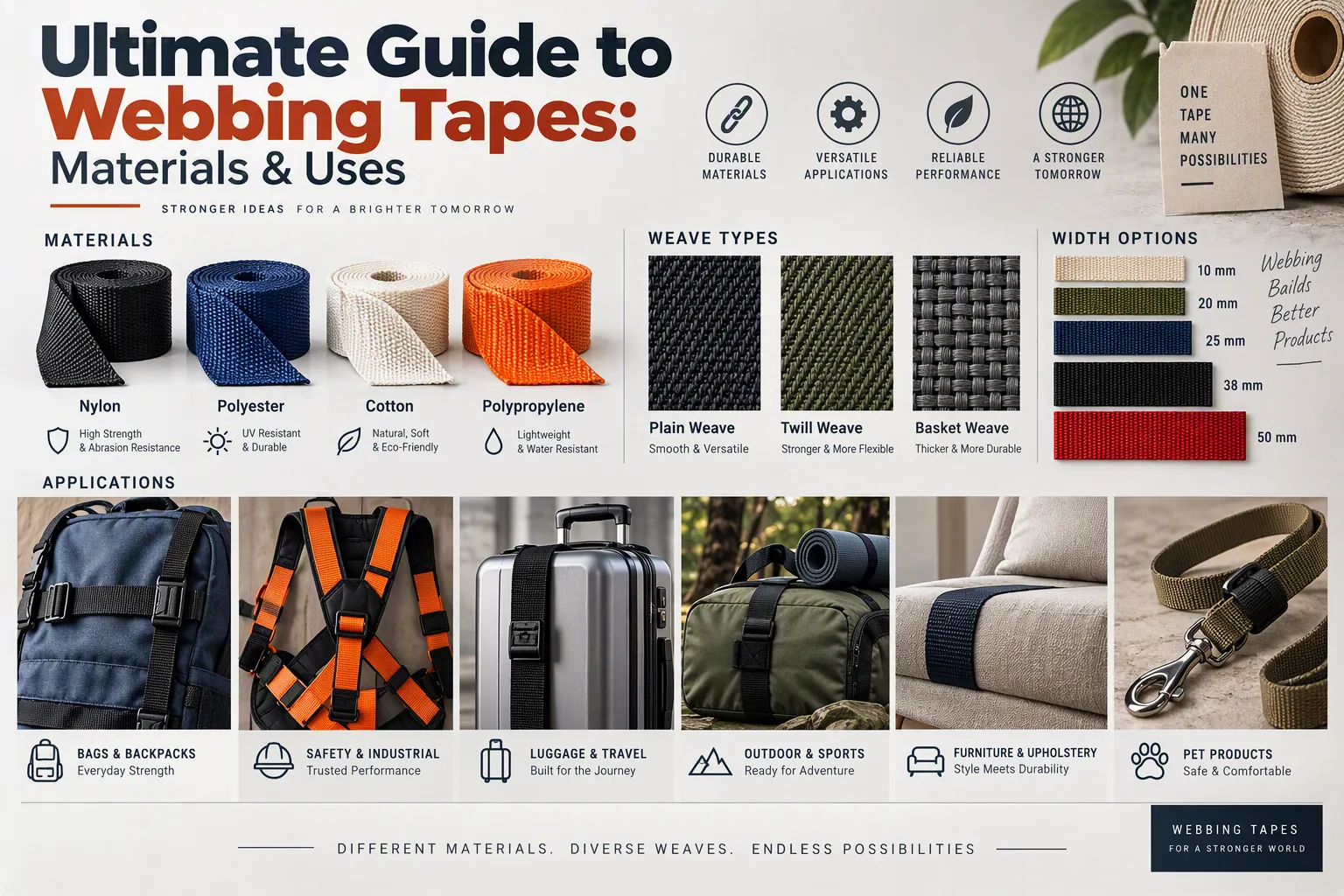
The most common materials include polypropylene, polyester, nylon and cotton.
- Polypropylene webbing is lightweight, economical and has very low moisture absorption. It is widely considered for bags, packaging, utility and general industrial applications.
- Polyester webbing provides strength, relatively low stretch, dimensional stability and good outdoor performance. It is common in luggage, outdoor products and industrial straps.
- Nylon webbing is valued for strength, toughness, flexibility and abrasion resistance. It is frequently used in backpacks, luggage and demanding equipment.
- Cotton webbing offers a natural hand feel and visual character suited to fashion, home textiles, canvas bags and lifestyle products.
The best material depends on the end use rather than a universal hierarchy.
Understanding Common Weave Structures
Webbing can be produced in plain, twill, herringbone-inspired and other constructions. Jacquard weaving can create logos, lettering or patterns within the tape.
Plain constructions can provide a clean, balanced surface. Twill structures create a diagonal visual effect and can influence flexibility and hand. Herringbone patterns are popular where texture and appearance are important. Jacquard webbing is particularly useful for branded straps.
Weave selection should consider both aesthetics and function. Denser structures may increase body and strength but can also affect sewing and flexibility.
Width, Thickness and Weight
Webbing dimensions must suit both the product and its hardware. Narrow straps can fit compact buckles, while wider tapes can distribute pressure more comfortably.
Thickness influences stiffness, durability and compatibility with adjusters. Weight per unit length can be useful for comparing constructions, particularly when overall product weight matters.
Buyers should specify acceptable tolerances because nominal dimensions alone may not provide enough control for automated sewing or closely fitted hardware.
Strength and Elongation
For functional webbing, tensile performance is an important specification. Breaking strength varies with material and construction, while elongation describes how the tape stretches under load.
A Webbing tape manufacturer in India can provide or discuss test data for specific constructions, but buyers must distinguish raw-webbing strength from the capacity of a finished product.
Stitching, knots, folds and hardware can reduce assembly strength. Safety-critical products require complete-system testing according to applicable standards.
Applications in Bags and Luggage
Bags use webbing for handles, shoulder straps, compression straps, loops and reinforcement. Polyester and nylon are frequently selected for demanding bag applications, while polypropylene offers an economical lightweight option and cotton provides a natural aesthetic.
Hardware compatibility is essential. Designers should test the webbing with buckles, sliders and rings to ensure it adjusts smoothly without excessive slipping.
Custom colours and jacquard patterns can turn the strap into a recognizable branding element.
Applications in Industrial Products
Industrial webbing may be used for handling, securing, equipment assemblies and other functional purposes. These applications often require controlled tensile performance, abrasion resistance and batch consistency.
Material selection should consider moisture, UV, chemicals, temperature and repeated loading. Where the webbing contributes to safety, the finished assembly must meet the relevant regulatory or industry requirements.
Heavy-duty should be treated as a technical specification rather than a marketing description.
Applications in Fashion, Furniture and Home Textiles
Cotton and other webbings can serve as handles, trims, belts, furniture components, storage-product straps and decorative details.
Fashion designers may prioritize colour, texture and hand feel, while furniture manufacturers may require denser constructions for support or reinforcement. Home textile exporters should consider washing, colourfastness and dimensional stability where applicable.
The same narrow woven technology can therefore support both decorative and technical product categories.
Custom Webbing Solutions
A custom webbing solution India project may involve special widths, colours, weave structures, fibre combinations, finishes or jacquard branding.
Successful customization begins with a detailed brief. Buyers should provide the application, material preference, dimensions, colour reference, quantity, hardware and performance requirements.
The manufacturer can then develop a sample. After testing and approval, that sample becomes the reference for bulk production. MOQ, development cost and lead time should be clarified at the beginning.
How to Source Webbing from India
When comparing suppliers, evaluate manufacturing capability, materials, quality controls, testing, customization, MOQ, lead time, export documentation and communication.
Send a complete RFQ rather than asking only for “best price.” Include drawings or physical samples where possible. If performance is important, define the test method and acceptance criteria.
A capable Webbing tape manufacturer in India should be able to discuss how construction choices affect the finished product and help narrow the available options.
Quality Control and Supplier Evaluation
Useful checks include width, thickness, weight, weave consistency, edge quality, colour, roll length and visible defects. Tensile, abrasion, colourfastness, dimensional stability or environmental tests can be added according to application.
Retain an approved master sample for repeat orders. For high-volume or critical programs, consider batch traceability and periodic verification.
Certification can support supplier evaluation, but it should be verified and understood in context. Management-system certification is not a substitute for product-specific testing.
Selecting the Right Webbing for Your Product
The simplest selection process is to start with function. Define what the webbing must carry, how it will be attached, what environment it will face and how it should look and feel. Then compare materials and constructions that satisfy those requirements.
Jawahar Group manufactures narrow woven fabrics/webbings and polypropylene multifilament yarn in India. Buyers exploring webbingtapes.com can share product requirements to discuss suitable standard or customized constructions.
This narrow woven fabrics guide covers the fundamentals, but every application has its own balance of strength, weight, flexibility, cost and aesthetics. Working with an experienced Webbing tape manufacturer in India allows product developers to move from a broad material choice to a controlled, production-ready specification and a practical custom webbing solution India program.