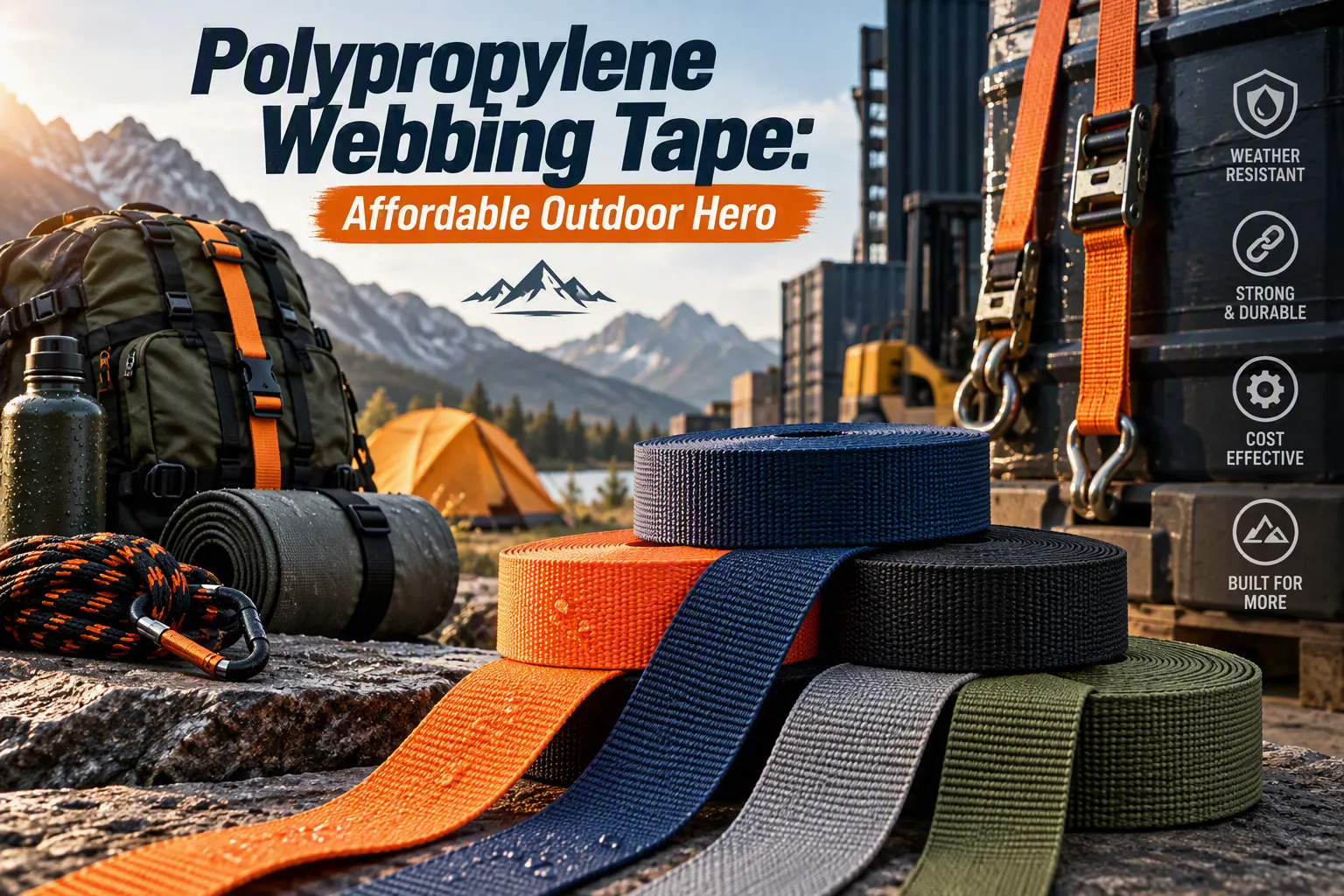
When manufacturers need a strap that is lightweight, practical and economical, polypropylene webbing tape is often one of the first materials considered. It is widely used across bags, packaging, outdoor accessories, agricultural products, utility straps and general industrial assemblies because it offers a useful balance of low weight, moisture resistance and cost.
The important point is that not every PP tape is the same. Yarn quality, denier, weave density, width, thickness and finishing all influence performance. Buyers should therefore select polypropylene webbing tape by specification and application rather than by price alone.
What Is Polypropylene Webbing Tape?
Polypropylene webbing tape is a narrow woven strap made from polypropylene yarn. The yarns are interlaced on narrow-fabric looms to create a flat tape in a required width and construction. The final webbing can be produced in different colours, weights, textures and weave patterns.
Polypropylene has a low density compared with many other common fibres, which helps create lightweight industrial straps. It also has very low moisture absorption, making it useful in products that may encounter damp conditions.
These characteristics make PP webbing attractive for high-volume applications where weight and cost matter.
Why Manufacturers Choose PP Webbing
The first advantage is weight. For luggage, backpacks, packaging and other products containing several metres of strap, material weight can influence both user comfort and shipping efficiency.
The second advantage is moisture behaviour. Polypropylene does not readily absorb water, so the tape itself is often suitable for damp or wet environments. It is more accurate to describe this as low water absorption or water resistance than to assume every finished assembly is completely waterproof. The term waterproof webbing should be used only when the relevant construction and performance have been validated.
The third advantage is economics. A PP webbing manufacturer can often provide cost-effective solutions for large-volume applications, especially when the product does not require the higher heat resistance or specific performance characteristics of other fibres.
Common Applications
Polypropylene webbing tape appears in many everyday and industrial products. Bag manufacturers use it for handles, shoulder straps, reinforcement and adjustable closures. Packaging companies use woven straps and handles for reusable packaging and carrying systems. Agricultural suppliers may use PP webbing in fastening, support and utility applications where low moisture absorption is helpful.
Outdoor product makers also consider polypropylene for non-critical straps, gear loops and general-purpose components. In industrial settings, lightweight industrial straps can be used for organization, securing, handling and product assembly when the required load is within the validated capability of the webbing.
Safety-critical applications require additional caution. Material selection, stitching, hardware and the complete assembly must be engineered and tested to the applicable requirements.
Strength Depends on Construction
It is tempting to assume that all webbing of a particular width has a predictable strength. That is incorrect. Tensile performance depends on yarn type, yarn denier, filament structure, weave, number of ends, density, thickness and manufacturing quality.
A dense 25 mm polypropylene webbing tape may perform very differently from a lighter 25 mm tape designed for decorative use. This is why buyers should request actual technical data or testing for the specific construction being quoted.
When sending an enquiry to a PP webbing manufacturer, state the expected load or target tensile requirement where relevant. This allows the manufacturer to recommend an appropriate construction instead of guessing from width alone.
Water, Chemicals and Outdoor Exposure
Polypropylene’s low moisture absorption is a major advantage in wet environments. It is also resistant to many chemicals, although chemical compatibility should be checked for the specific substance, concentration, temperature and exposure time.
Outdoor exposure introduces another factor: ultraviolet radiation. Untreated polymers can degrade under prolonged UV exposure. If the webbing will be used outdoors for extended periods, discuss UV stabilization and expected service conditions with the manufacturer.
Polypropylene Versus Polyester and Nylon
Polypropylene is generally lighter and more economical, while polyester is often selected for higher strength, dimensional stability, UV performance and lower stretch in demanding applications. Nylon is known for high strength, flexibility and abrasion resistance but can absorb more moisture than polypropylene.
There is no universal winner. The right material depends on load, environment, desired feel, appearance, cost and regulatory requirements.
For a low-cost reusable bag handle, polypropylene webbing tape may be an excellent fit. For a heavily loaded outdoor restraint, a different fibre or a specially engineered PP construction may be more appropriate. Material decisions should always be linked to the finished product.
Width, Thickness and Hand Feel
PP webbing can range from soft and flexible to firm and dense. Bag brands may prefer a smoother hand feel, while industrial users may need a thicker, more rigid construction.
Width affects comfort and load distribution. A wider strap can spread pressure over a larger area, while a narrow strap may fit smaller hardware or compact product designs. Thickness must also be compatible with buckles, adjusters, loops and sewing equipment.
During sampling, run the tape through the exact hardware intended for production. Check whether it slips under tension, jams in the buckle or becomes difficult to stitch when folded.
Colour and Customization
Polypropylene can be produced in a wide range of colours, and colour can become an important part of product identity. For large branded programs, establish an approved colour reference and acceptable tolerance.
Custom PP webbing may also include different weave patterns, textures and widths. Some applications may require special finishes or treatments. The feasibility, MOQ and lead time depend on the manufacturer and specification.
A PP webbing manufacturer should be given enough information to assess whether the requested customization affects strength, flexibility or production efficiency.
Quality Control for PP Webbing
Useful inspection points include width consistency, thickness, weight per unit length, edge quality, weave defects, shade variation, roll length and joins. Where strength is important, tensile testing should be part of the approval process.
Buyers should also inspect how the webbing performs after sewing. Needle damage, stitch density and seam design can influence the strength of the final assembly. The webbing and stitching should therefore be considered as a system.
Cost-Effective Does Not Mean Lowest Specification
The real value of polypropylene webbing tape comes from matching performance to need. Over-specifying a simple bag handle can add unnecessary cost, while under-specifying an industrial strap can create failures and returns.
A good sourcing process identifies the minimum performance required with an appropriate safety margin and then selects the most efficient construction that meets it. This is more reliable than purchasing the cheapest tape available.
Working with an Indian Manufacturer
Jawahar Group manufactures polypropylene multifilament yarn and narrow woven fabrics/webbings in India, giving it relevant material and weaving expertise for PP-based solutions. Buyers visiting webbingtapes.com can share their required width, colour, application, quantity and performance expectations for product discussion.
For outdoor equipment makers, bag manufacturers and packaging suppliers, polypropylene webbing tape remains a versatile material because it combines low weight, low moisture absorption and economical production. The key is to treat it as an engineered textile component: specify the construction, test the sample, validate the final assembly and work with a PP webbing manufacturer that can reproduce the approved quality consistently.