
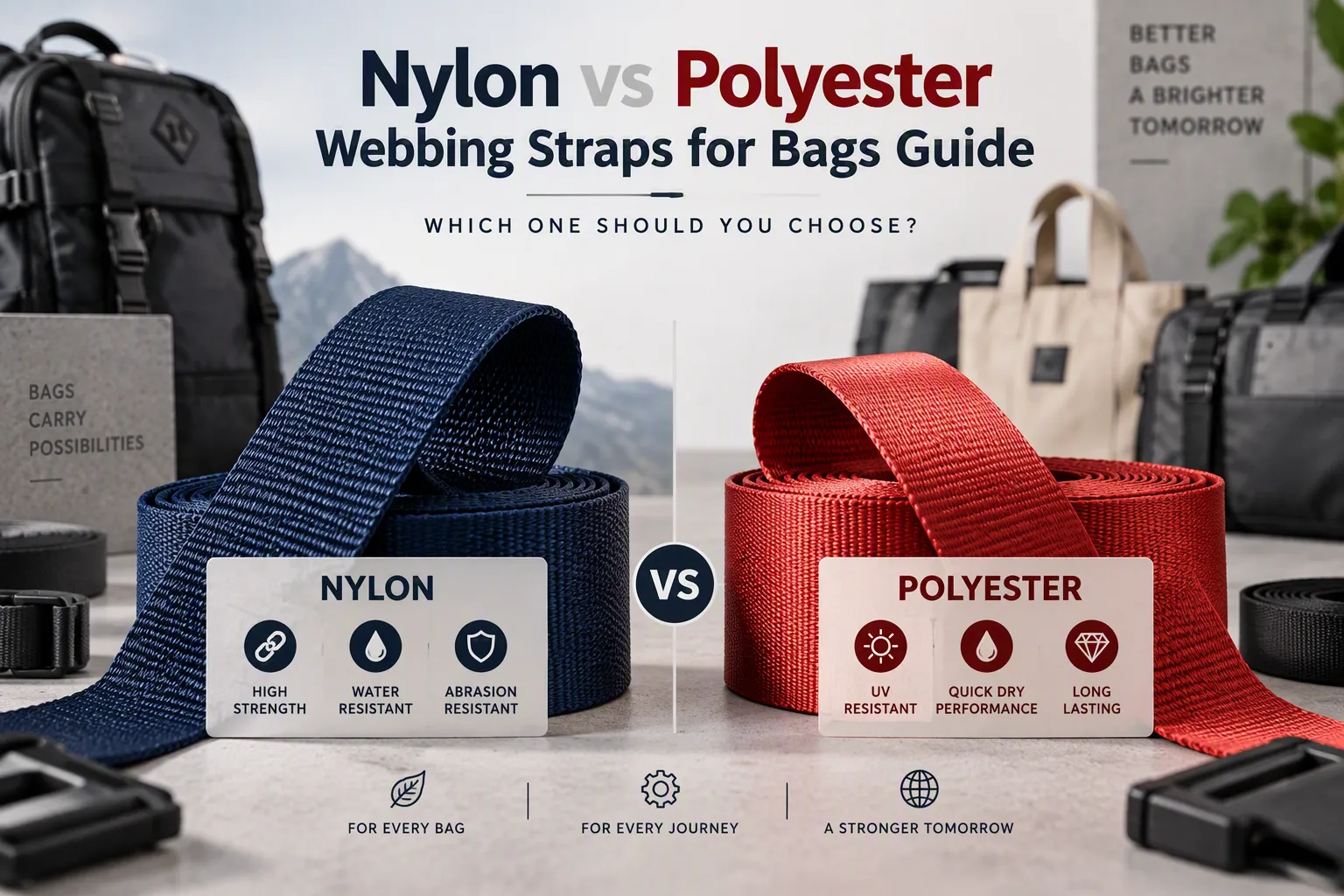
For backpack and luggage designers, the strap is one of the most frequently handled parts of the product. It is pulled, adjusted, folded, stitched, rubbed against clothing and repeatedly loaded. Choosing between polyester webbing straps and nylon webbing straps for bags therefore affects comfort, durability, appearance and manufacturing performance.
Both fibres can produce excellent webbing, but they behave differently. The right choice depends on the product, environment and required performance—not on a blanket claim that one material is always better.
Why Fibre Choice Matters
A bag strap has to do more than carry weight. It must work with buckles and adjusters, resist abrasion, hold stitching, maintain an acceptable appearance and feel comfortable in use. For outdoor or tactical products, it may also face moisture, sunlight, dirt and repeated mechanical stress.
When evaluating polyester webbing straps and nylon webbing straps for bags, designers should compare the specific constructions being offered. Fibre is important, but yarn denier, weave density, thickness and finishing can create major differences even within the same material family.
Nylon Webbing: Strength and Flexibility
Nylon is widely valued for high tensile strength, toughness and abrasion resistance. It can have a smooth, premium feel and good flexibility, which makes it attractive for backpacks, luggage and tactical-style products.
Its elasticity can be useful where some give is acceptable, but additional stretch may be undesirable in applications that require high dimensional stability. Nylon can also absorb more moisture than polyester, which may affect weight, drying behaviour and dimensions in wet conditions.
For abrasion-resistant bag straps, a dense nylon construction can perform very well, but the actual result should be confirmed through testing rather than assumed from fibre name alone.
Polyester Webbing: Stability and Outdoor Performance
Polyester webbing is known for strong dimensional stability, relatively low stretch and good resistance to UV exposure compared with many common fibres. It also has low moisture absorption, helping it retain more consistent behaviour in damp environments.
These properties make polyester attractive for outdoor luggage, travel gear, straps that need to hold adjustment and products exposed to sunlight.
For heavy-duty backpack webbing, polyester can be engineered in dense constructions that provide a firm hand and controlled elongation. Again, the correct specification depends on the target load and hardware.
Strength: Look Beyond the Material Name
Buyers often ask whether nylon or polyester is stronger. That question cannot be answered accurately without comparing specific products. A heavy polyester tape can outperform a lightweight nylon tape, and vice versa.
The correct comparison is tensile strength for the actual width and construction. Ask your bag strap webbing supplier for test data or arrange testing on approved samples. If the strap is part of a load-bearing assembly, test the sewn assembly because seam efficiency and hardware can become the weakest points.
Design teams should define a performance requirement first and then evaluate materials that meet it.
Stretch and Shape Retention
Nylon generally has more elasticity than polyester. In some products, this can make the strap feel more forgiving. In others, stretch can cause a loaded bag to sit lower or an adjusted strap to change length under load.
Polyester is often preferred when low stretch and dimensional stability are priorities. This can be valuable in luggage, tool bags and structured backpacks where the designer wants the strap length to remain more consistent.
Prototype testing with realistic loads is the best way to determine whether the difference matters for the user experience.
Moisture and Drying
For travel and outdoor bags, wet conditions are an important design consideration. Polyester absorbs relatively little moisture, while nylon is more hygroscopic. A wet nylon strap can therefore behave differently from a dry one.
This does not automatically make nylon unsuitable for outdoor products. Many successful outdoor products use nylon. It simply means the complete specification, coating or finish, construction and intended environment should be considered.
If quick drying is a major requirement, compare samples after controlled water exposure and assess weight, feel, drying time and dimensional change.
Abrasion Resistance
Both fibres can be used for abrasion-resistant bag straps. Nylon has a strong reputation for abrasion performance, while polyester also provides good durability in many bag applications.
Surface texture and weave are crucial. A rough or open weave may catch on hardware or clothing, while a dense, smooth tape may move more cleanly through adjusters. Edge construction matters too because strap edges receive repeated rubbing.
Designers should test the webbing against the actual buckle, ladder lock or D-ring used in the bag. Laboratory abrasion testing can be supplemented with repeated adjustment cycles on the finished assembly.
UV Exposure
For products that spend significant time outdoors, UV resistance becomes important. Polyester generally offers good resistance to sunlight, while nylon may require additional consideration for prolonged UV exposure.
A bag strap webbing supplier should be told whether the product is intended for urban, travel, outdoor or tactical environments so the recommended material can reflect real use.
Feel, Appearance and Colour
Nylon is often associated with a smooth, rich hand feel and can work well in premium luggage. Polyester can also be produced with an attractive, clean finish and is available in numerous constructions.
Colour matching should be evaluated on the final webbing, not only on yarn or digital references. The same colour target can appear different on nylon and polyester because fibre chemistry and surface characteristics influence dyeing and light reflection.
Sewing and Hardware Compatibility
Heavy-duty backpack webbing may require stronger needles, different stitch patterns or adjusted machine settings. Excessive density can make sewing difficult, while an overly soft tape may bunch or distort.
Before finalizing a material, build production-representative samples and involve the factory sewing team in approval.
Cost and Product Positioning
Cost differences between nylon and polyester depend on yarn, construction, market conditions, quantity and finishing. Rather than selecting by fibre price alone, calculate the impact on the complete product.
If a slightly more expensive webbing improves durability, reduces returns or supports a premium product position, the total value may justify the difference. Conversely, an over-engineered strap can unnecessarily increase cost on a basic promotional bag.
The best specification delivers the required performance without paying for properties the product does not need.
A Practical Selection Framework
Choose based on measurable priorities. If low stretch, dimensional stability and outdoor exposure are central, polyester may deserve strong consideration. If flexibility, toughness and a particular hand feel are priorities, nylon may be attractive. Where either material can meet the requirement, compare samples on strength, abrasion, hardware grip, sewing, colour and cost.
Jawahar Group supplies narrow woven webbing solutions and has experience with synthetic webbing materials. Buyers using webbingtapes.com can share their bag design, target width, hardware, colour and performance requirement to discuss a suitable construction.
Ultimately, choosing polyester webbing straps and nylon webbing straps for bags is an engineering and design decision. The most reliable approach is to define the requirement, source representative samples from a capable bag strap webbing supplier, test the complete sewn assembly and approve the material that best supports the finished product.