Why Supplier Verification Matters
Industrial webbing may be a small component, but inconsistency can create significant problems in manufacturing and field performance. Width variation can affect buckles, shade differences can disrupt branded products and inadequate tensile performance can create serious risk in load-bearing applications.
For procurement and quality teams, selecting an industrial webbing strap supplier requires more than comparing quotations. The manufacturer’s process controls, testing capability, traceability and documentation should be evaluated before long-term approval.
Begin with a Detailed Technical Specification
Quality cannot be verified without a clear definition of what “good” means. The purchasing specification should identify fibre, width, construction or reference sample, colour, thickness where relevant, roll length, packaging and performance requirements.
If tensile strength is critical, specify the required value and test method. If the webbing is exposed to sunlight, chemicals or washing, define relevant performance criteria.
A narrow fabric supplier can quote more accurately when the RFQ includes the end use and measurable acceptance criteria.
Verify the Manufacturer, Not Just the Trader
International buyers should understand who actually manufactures the webbing. Ask where weaving, dyeing, finishing and inspection take place and whether any stages are subcontracted.
A manufacturer should be able to explain its loom capability, materials handled, width range, customization options and quality-control process. Factory audits—physical or remote—can help procurement teams verify production capability for high-volume or critical programs.
The objective is not to eliminate subcontracting automatically, but to understand the supply chain and identify who controls each process.
How to Evaluate Certification Claims
Search terms such as Certified webbing manufacturer India and ISO quality webbing are common in B2B sourcing, but buyers should verify certificates rather than relying on website claims.
Check the certificate’s issuing body, scope, site address, standard, validity dates and whether the certification applies to the facility producing your goods. ISO 9001, for example, relates to a quality management system; it does not by itself certify that every webbing product meets a particular tensile strength.
Product-specific compliance and management-system certification should be treated as separate evidence.
Request Representative Samples
Samples allow quality teams to evaluate the actual construction before committing to bulk orders. Measure width, thickness, weight per unit length where relevant and inspect edges, weave uniformity, colour and surface defects.
Test the sample in the intended application. Sew it with production equipment, route it through hardware and expose it to representative loads or environmental conditions.
An industrial webbing strap supplier should be willing to establish an approved reference sample that can later be used for bulk comparison.
Understand the Testing Process
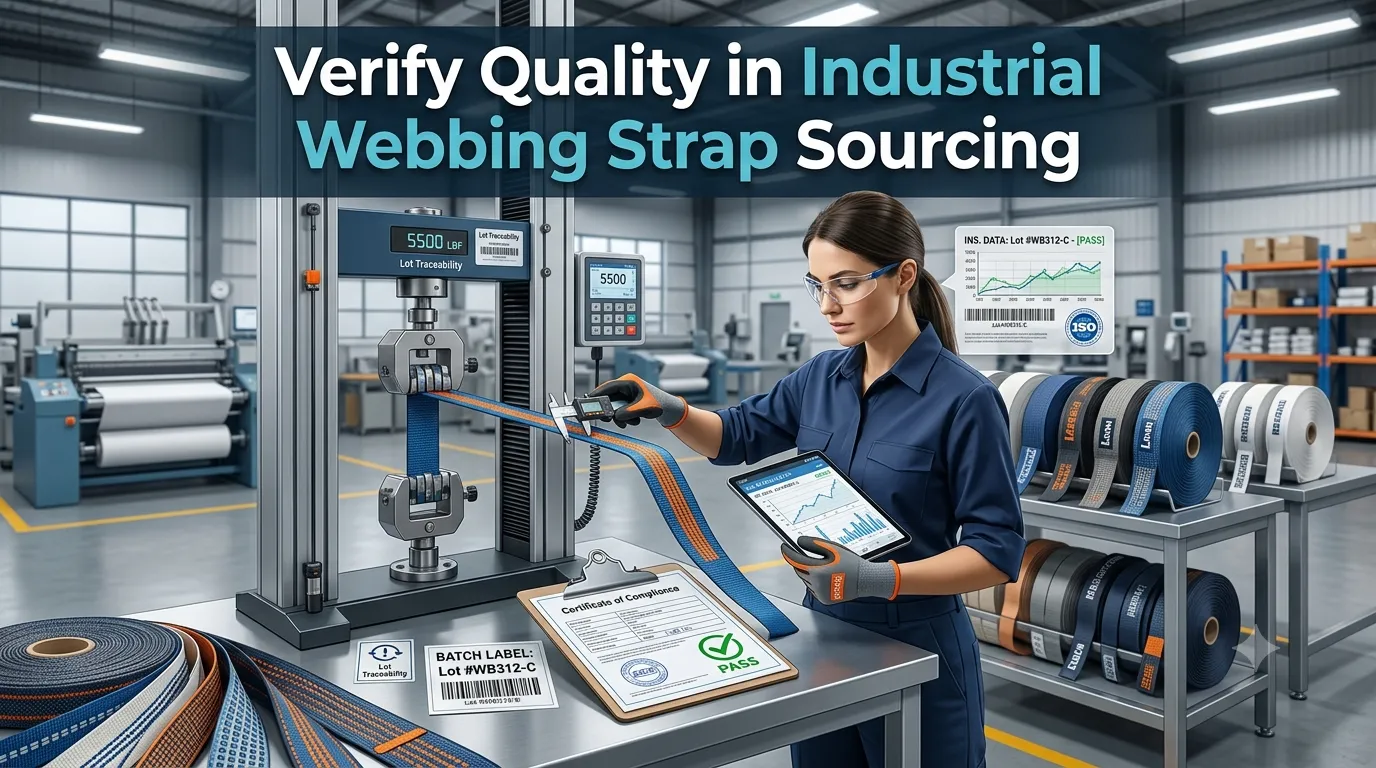
Ask which tests are performed in-house and which are sent to external laboratories. For tensile testing, confirm specimen preparation, test method and reporting format.
Depending on application, other tests may include abrasion, colourfastness, dimensional stability, UV exposure or chemical resistance. Not every webbing needs every test; the quality plan should be risk-based.
For safety-critical products, applicable standards and regulatory requirements must guide testing. The finished assembly may require separate validation beyond raw-webbing results.
Assess Batch Consistency
A perfect development sample is not enough if bulk production varies. Ask how yarn lots, loom settings, dye lots and finished rolls are controlled.
Useful production checks can include width, appearance, mass, shade and tensile performance. The manufacturer should have a method for identifying non-conforming material and preventing unintended shipment.
Repeat orders should reference the approved specification and master sample. Statistical or batch-based inspection can be added where volume and risk justify it.
Traceability and Documentation
Traceability helps connect delivered webbing to its manufacturing batch. This is particularly valuable for industrial, export, defence and safety-related programs.
Purchase orders, production batch numbers, inspection records and packing labels should align. If a problem is discovered, the supplier should be able to identify the relevant production history and investigate the cause.
International buyers may also require commercial documents, country-of-origin information, test reports or declarations depending on their market and product category.
Audit Communication and Corrective Action
Supplier quality is visible not only when production runs smoothly but also when something goes wrong. Ask how complaints and non-conformities are investigated.
A disciplined corrective-action process identifies the root cause, contains affected material, implements corrective measures and verifies effectiveness. Vague assurances without evidence are less useful than documented analysis.
Procurement teams should also evaluate response time, technical communication and willingness to share data. These factors strongly influence the cost of managing a supplier relationship.
Compare Total Cost, Not Unit Price
A low price can become expensive if webbing causes sewing downtime, rejected goods, late deliveries or customer claims. Total cost includes quality consistency, lead time, MOQ, testing, logistics, communication and defect risk.
A dependable narrow fabric supplier can reduce hidden costs by providing repeatable material and accurate documentation.
For strategic sourcing, buyers can use a supplier scorecard covering quality, delivery, cost, responsiveness and improvement performance rather than making decisions on price alone.
A Practical Supplier-Approval Checklist
Before approving an industrial webbing strap supplier, confirm manufacturing capability, material source, specification control, sample approval, testing, certification validity where required, traceability, batch inspection, packing and corrective-action procedures.
Jawahar Group manufactures narrow woven fabrics/webbings in India and supports industrial and product-development requirements. Buyers using webbingtapes.com can submit their technical specifications and application details for discussion.
For teams searching for a Certified webbing manufacturer India or ISO quality webbing, verification should remain evidence-based. Certificates are useful, but reliable sourcing ultimately depends on controlled processes, appropriate testing and consistent production. The strongest supplier relationship is one in which both buyer and manufacturer work from the same measurable specification.