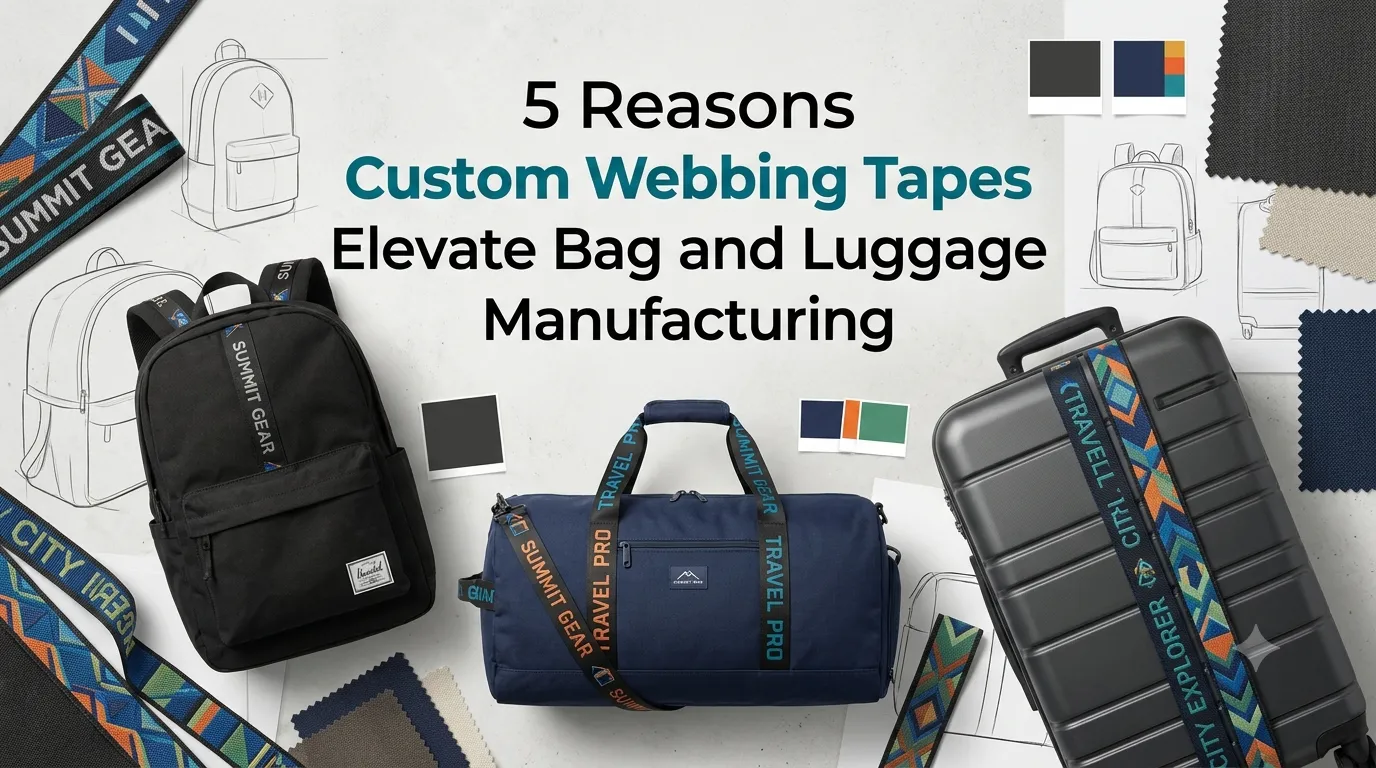
In bag and luggage manufacturing, webbing is often one of the most visible functional components. It forms shoulder straps, carry handles, compression straps, loops, trims and reinforcement points. Using a generic tape can work, but custom webbing gives brands far greater control over both product performance and identity.
For designers sourcing polyester webbing straps and nylon webbing straps for bags, customization is not simply about adding a logo. Width, colour, weave, thickness, texture and hardware compatibility can all be engineered around the finished product.
Here are five reasons custom webbing can elevate a bag or luggage range.
1. Custom Webbing Turns a Functional Strap into Brand Identity
Most bags have a limited number of elements that customers touch repeatedly. Handles and shoulder straps are among them. This makes webbing a branding surface.
Custom jacquard webbing can weave text, logos or patterns directly into the tape, creating a more integrated appearance than a separate label. Branded bag straps can also use signature colours, repeating motifs or contrasting textures that make a product recognizable from a distance.
2. Custom Colour Creates a More Cohesive Collection
Stock webbing colours can limit design options. A near-match may be acceptable on a utility product but can look noticeably wrong on premium luggage or coordinated fashion collections.
Custom dyed webbing tape allows designers to work toward a specific colour target, subject to fibre, dye process, MOQ and manufacturing capability. Matching can be particularly important when the strap sits next to coated fabric, leather, zipper tape or molded plastic hardware.
Polyester webbing straps and nylon webbing straps for bags can take colour differently, so approval should always be made on the final fibre and construction. A colour that looks identical in a digital file may appear different on two textile surfaces.
For repeat production, brands should retain an approved physical standard and agree on acceptable shade tolerance.
3. Performance Can Be Engineered Around the Bag
Customization can improve function as much as appearance. A bag strap can be designed around the required width, thickness, flexibility and tensile performance.
For a lightweight fashion bag, the webbing may need to feel soft and drape cleanly. A travel duffel may need a denser strap with greater resistance to abrasion. Heavy luggage may require a wider tape to distribute load more comfortably.
When specifying polyester webbing straps and nylon webbing straps for bags, product teams can also consider stretch, moisture exposure, UV conditions and the intended service life.
The most effective custom development starts with the use case. Instead of asking a manufacturer for “premium webbing,” describe the bag, expected load, user, environment and hardware. That information can guide construction decisions.
4. Better Hardware Compatibility Improves User Experience
Straps and buckles work as a system. A tape that is too thin may slip through an adjuster. A tape that is too thick may jam or become difficult to feed. A rough surface may make adjustment frustrating, while an overly smooth construction may not hold position under load.
Custom webbing allows the tape to be developed around the selected buckle, ladder lock, D-ring or slider. Width tolerance is especially important because even a small mismatch can affect assembly and adjustment.
Designers should test the exact production hardware with representative webbing samples. Pull the strap repeatedly, load the bag, adjust it while worn and check for edge wear.
This is particularly important for branded bag straps because the visual design must not compromise the mechanical interaction with hardware.
5. Custom Webbing Helps Differentiate Products Without Redesigning the Entire Bag
A neutral bag body can be paired with bold custom dyed webbing tape. A basic travel bag can gain a premium feel through a dense woven strap with subtle jacquard branding. Promotional products can incorporate campaign colours or event-specific text directly into the handle.
This flexibility makes webbing a useful tool for product-line extension. Brands can create variation while retaining proven bag construction, patterns and tooling.
Choosing Between Polyester and Nylon for Custom Bag Webbing
Both polyester and nylon can be excellent choices. Polyester is often valued for dimensional stability, low stretch and good outdoor performance. Nylon is known for strength, flexibility, abrasion resistance and a smooth hand.
The final decision should be based on the specific tape construction and end use. A custom sample should be evaluated for tensile performance, stretch, feel, colour, abrasion, sewing and hardware grip.
For high-volume luggage, consistency across batches is as important as the first sample. Ask the manufacturer how dimensions, shade and weave are controlled during production.
Jacquard Webbing: Branding Woven into the Structure
Custom jacquard webbing is particularly attractive for brands that want a permanent woven graphic. Because the pattern is created through yarn arrangement, it becomes part of the textile rather than a surface-only print.
Jacquard can be used for logos, geometric patterns, lettering and repeating motifs. Design feasibility depends on tape width, yarn size, pattern complexity and loom capability. Fine details that look good on a screen may need simplification to weave clearly.
Request a development sample before approving bulk production. Review both sides of the tape, pattern repeat, edge quality and how the design looks after folding or passing through hardware.
Printing Versus Woven Branding
Neither method is universally superior. Consider durability, colour, minimum quantity, design complexity, hand feel and cost. For either method, test resistance to rubbing and normal use.
Sewing Considerations for Custom Webbing
A beautiful tape is not useful if it creates production problems. Before bulk ordering, sewing teams should test the webbing on the actual machines and seam configurations.
Check needle penetration, edge fraying, fold thickness and whether the tape distorts under the presser foot. Dense or heavy webbing may require adjustments to needle, thread or machine settings.
For load-bearing handles, test the complete seam. The strength of polyester webbing straps and nylon webbing straps for bags can only contribute to product durability when the attachment is properly engineered.
Building a Better Custom-Webbing Brief
A clear development brief should include fibre preference, width, thickness or reference sample, colour standard, weave or visual direction, logo artwork, quantity, roll length, intended hardware, end use and performance requirements.
Also identify whether the tape will be used outdoors, washed, exposed to chemicals or expected to carry significant loads. These details can affect material and finishing recommendations.
If you are replacing an existing webbing, send a physical sample and explain what you want to improve—cost, feel, strength, colour, branding or lead time.
From Sample to Bulk Production
Custom development should follow a controlled approval process. First, align on the specification. Next, review a sample for dimensions, appearance and function. Then test it in the finished bag. Finally, approve a master sample and define bulk tolerances.
Jawahar Group manufactures narrow woven fabrics/webbings and supports customized textile solutions for different applications. Brands exploring webbingtapes.com can share their design and technical requirements for development discussion.
Custom webbing gives luggage and fashion brands a rare opportunity to improve function and identity with the same component. Whether you need custom jacquard webbing, branded bag straps, custom dyed webbing tape, or specially engineered polyester webbing straps and nylon webbing straps for bags, the strongest results come from treating the strap as an intentional part of product design—not an afterthought.