

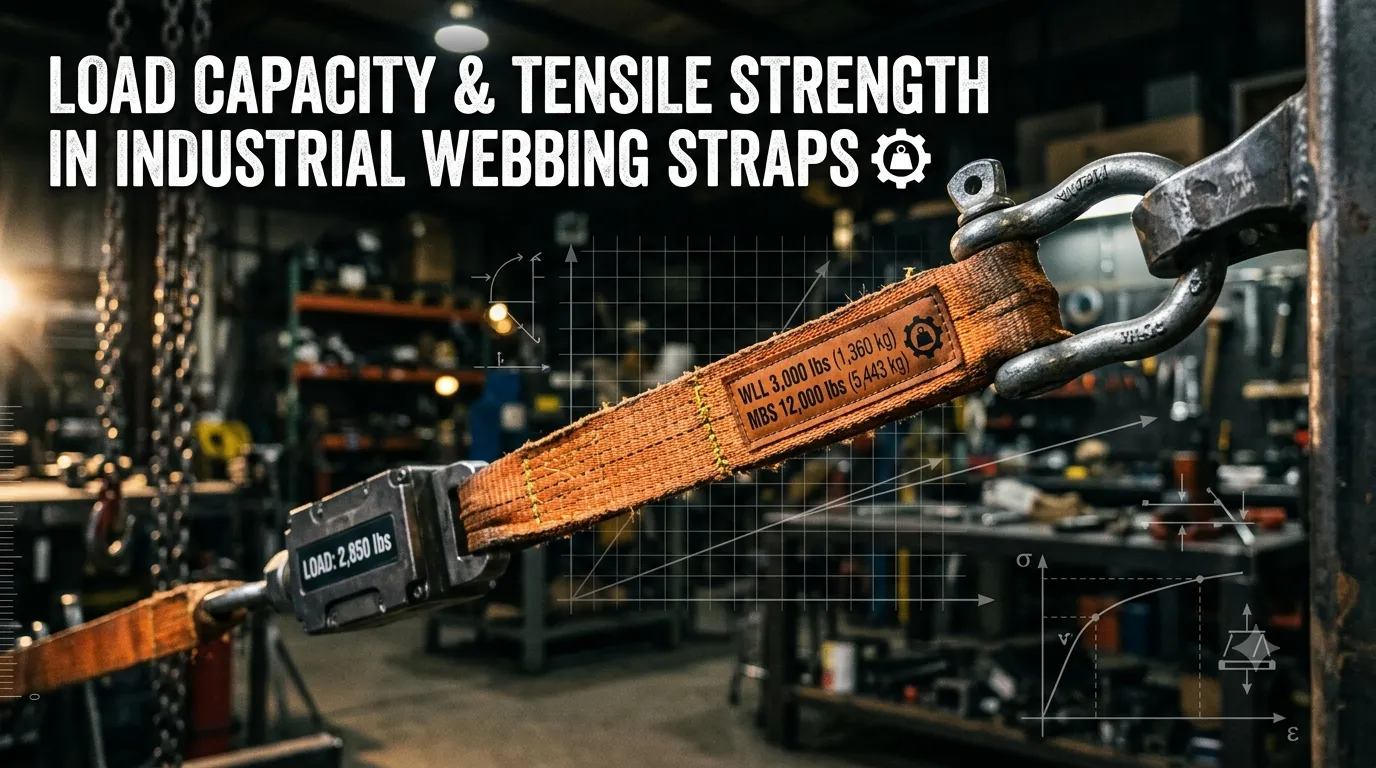
In industrial applications, webbing is often selected for jobs where failure can damage products, interrupt operations or create serious safety risks. Yet terms such as tensile strength, breaking strength, working load and load capacity are sometimes used interchangeably even though they do not mean the same thing.
For any buyer working with an industrial webbing strap supplier, understanding these terms is essential. A strap should never be selected only because it “looks heavy duty.” Its material, construction, test method, stitching, hardware and final assembly must all be matched to the intended use.
Tensile Strength: What It Actually Means
Tensile strength testing measures how a material behaves when pulled until it breaks or reaches a defined endpoint under a specified test method. For webbing, the reported result is typically associated with a particular specimen width, conditioning procedure and test setup.
A breaking-strength figure is not automatically the safe working load of a finished strap. The value may describe only the webbing material before it is sewn, folded, knotted or connected to hardware.
This distinction is critical when sourcing high-tensile webbing straps. Ask the supplier exactly what was tested and under which standard or procedure.
Working Load Is a System-Level Decision
The allowable working load of an industrial assembly is normally lower than its minimum breaking strength. The relationship depends on the applicable standard, product category, design factor, regulations and operating environment.
Buyers should not create an arbitrary working-load claim by dividing a webbing tensile value by a convenient number. Safety factors must be determined by qualified product engineers and the requirements governing the final product.
An industrial webbing strap supplier can provide material data, but the manufacturer of the finished lifting, restraint or safety product remains responsible for validating the complete assembly.
Why Webbing Construction Changes Strength
Webbing performance depends on more than fibre type. Yarn denier, filament characteristics, number of warp ends, weave pattern, density, thickness, edge construction and finishing all influence tensile behaviour.
Two rolls of heavy-duty industrial webbing with the same width and colour may have very different breaking strengths. Visual inspection alone cannot establish capacity.
This is why a technical specification should identify the approved construction or measurable performance criteria. For repeat production, quality control should confirm that the bulk material remains consistent with the approved reference.
Fibre Selection
Polyester is commonly used in demanding webbing applications because it combines strength, relatively low stretch, abrasion resistance and good dimensional stability. Nylon offers high strength, toughness and elasticity, which can be useful in selected applications. Polypropylene is lightweight and moisture resistant and may be suitable for many utility and industrial uses when the required performance is within the validated specification.
The best fibre depends on the application. Cargo lashing webbing, safety harness components and equipment straps can have different requirements even when they appear similar.
Environmental exposure—including water, UV, chemicals, heat and abrasion—should be part of material selection.
The Effect of Stitching
A webbing roll may achieve an impressive tensile result, but the sewn assembly can fail at a lower load if the seam is poorly designed. Stitch pattern, thread type, stitch density, overlap length and needle damage can all influence joint efficiency.
For industrial products, sewing is an engineered connection. Box-X patterns, multiple rows and other configurations may be used, but no pattern should be assumed safe without validation for the actual material and load.
Testing should be performed on production-representative assemblies, not only on unsewn webbing.
Hardware Can Become the Weakest Link
Buckles, hooks, rings, adjusters and metal fittings introduce stress concentrations and bending. A strap may fail near the hardware even when the webbing’s straight tensile strength is higher.
Hardware geometry can also cut or abrade the fibres. Sharp edges, small radii and rough surfaces can reduce durability over repeated loading cycles.
When developing high-tensile webbing straps, source and test the webbing together with the intended hardware. If hardware changes, the assembly may need revalidation.
Cargo Lashing Requires Specific Compliance
Cargo lashing webbing is a specialized application. Requirements can vary by market, transport mode and product design. Buyers should identify the applicable standard and ensure the finished restraint system—not just the raw tape—is tested and marked accordingly.
Do not rely on generic “heavy duty” descriptions for load restraint. The product documentation should clearly state the relevant rated capacity, test basis, traceability and usage limitations where required.
Logistics companies should also inspect straps in service and remove damaged products according to their safety procedures.
Abrasion, Cuts and Service Damage
Industrial webbing can lose strength through wear even when it has never experienced a catastrophic overload. Abrasion can thin yarns, cuts can sever load-bearing fibres and chemical contamination can degrade material.
Edges deserve special attention because they often rub against equipment or cargo. Protective sleeves, corner protectors or improved routing may be needed where the strap contacts sharp surfaces.
A good heavy-duty industrial webbing specification considers both initial strength and the real environment in which the strap will operate.
UV, Moisture and Chemicals
Outdoor service can expose webbing to sunlight, rain, dirt, oils and cleaning chemicals. Different polymers respond differently to these conditions.
If UV exposure is expected, discuss stabilization and weathering requirements. If chemicals are present, verify compatibility with the exact chemical and concentration. If temperature is elevated, confirm that the material is suitable for the operating range.
An industrial webbing strap supplier should be given these environmental details during development because they can influence fibre and finish selection.
Batch Testing and Traceability
For critical industrial products, quality assurance should extend beyond a first sample. Buyers may require incoming inspection, batch identification, certificate documentation and periodic testing.
Useful controls can include width, thickness, mass per unit length, visual defects and tensile testing. The frequency should be based on risk, volume and applicable standards.
Questions to Ask Your Supplier
Before approving an industrial webbing, ask what fibre and yarn specification is used, what tensile test method applies, what tolerances are controlled, whether special finishes are available and how batch consistency is monitored.
Also clarify whether the quoted strength applies to raw webbing or a finished assembly. Request representative samples and test them in your own product configuration.
For custom projects, provide drawings, target loads, hardware details, environmental conditions and any mandatory standard. The more complete the engineering brief, the more useful the supplier’s recommendation will be.
Avoiding Common Specification Mistakes
One common mistake is selecting by width alone. Another is assuming thicker always means stronger. A third is treating breaking strength as a safe working load. Buyers also sometimes change buckles or stitching without retesting the assembly.
Jawahar Group manufactures narrow woven fabrics/webbings in India and can discuss custom constructions based on application requirements. Procurement teams using webbingtapes.com should share the intended use and technical criteria when requesting heavy-duty industrial webbing or other high-performance tapes.
A dependable industrial webbing strap supplier provides more than a roll of fabric. The real value lies in consistent construction, transparent specifications and support for a disciplined testing process. When load capacity matters, verified data and complete-system validation should always take priority over assumptions.